


Today I begin a 5-week online course at SUNY MCC to help improve my technical writing skills. I could have taken my usual approach to learning – utilize self-study via various books and online videos. Instead, I wanted to do something different for this endeavor. I’ve always enjoyed having clear goals outlined by a course or certification study as well as benchmarking my skills against a standard. In order to ensure I was improving my skills, I enrolled a course at my local community college so that I could have community around me as well as direct feedback on my efforts from a professor. I hope to learn more effective ways to convey complex technical ideas in the various forms of communication I use daily including emails, presentations, and blog articles.
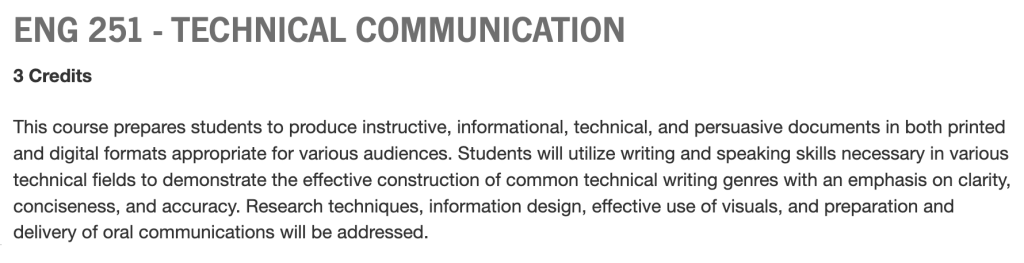
Technical writing is important across engineering domains and network and cybersecurity engineers are no exception. There are routine items that require a high level of technical writing ability:
- Email correspondence
- Documentation
- Project proposals
- Change proposals and evidence
- Report generation
- Presenting ideas to colleagues, management, or customers
The ability to clearly and concisely present information on complex topics cannot be overstated.
In my first two chapters of reading, I have found helpful information I haven’t thought about previously and am excited to share additional insights I come across. Some of the highlights so far include:
- Traditional writing is author driven – for example an author has an idea and begins to write to share that with an anonymous audience. Technical writing is audience driven – it is created to respond to a specific audience’s need for information.
- Technical writers must expect their audience to skim their articles and select what they need. There is a timeliness to their writing since technology continues to change and advance.
- There is both a connotative (emotional response) and denotative (objective meaning) to technical writing to be aware of.
- Finally, engineers should approach technical writing with CMAPP in mind – Context, Message, Audience, Purpose, and Product.
- Context – relationship, time/place, external/internal influences.
- Message – what is the main point you are trying to convey. Is there a secondary message?
- Audience – who is the primary audience you intend to deliver the message to as well as secondary audience that may need consideration. What does my audience want to know?
- Purpose – inform, persuade, instruct, or describe. Why do I want to communicate and why would the audience want the message?
- Product – what is the proper media – email, call, visit, presentation.
Resources
Course Text – Engineering Communication, 2nd edition by David Ingre and Robert Basil ISBN-13: 978-1-305-63510-4